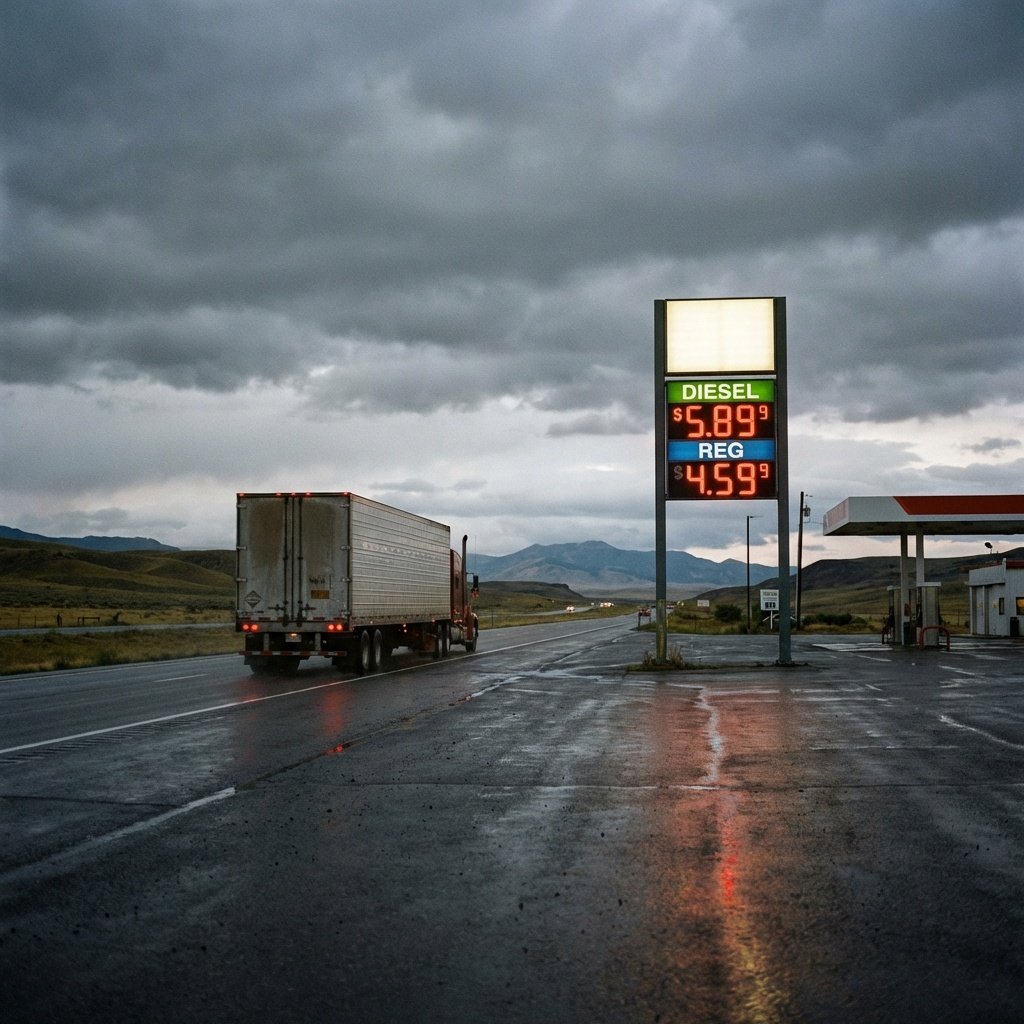
What the War in Iran and Surging Diesel Prices Mean for Your Freight Budget Right Now

Elise Strecker
Diesel crossed $5 a gallon in March. Your freight invoices haven't caught up yet; but they will. Here's what's happening, what's coming, and how the smartest operators are getting ahead of it.
If you've filled up your car recently, you already know something is different. But what's happening at the pump is only the surface of a much deeper disruption; one that is working its way through every freight lane, every carrier contract, and every supply chain in the United States right now.
In late February 2026, military escalation involving Iran introduced immediate uncertainty into global energy markets. Reports of disruption risk in the Strait of Hormuz, a corridor responsible for roughly 20% of global oil flow, drove rapid price movement.
While conditions on the ground remain fluid, energy markets reacted as though supply could tighten in the near term.
$3.01 → $5.37Diesel price per gallon, March 2–16, 2026. A 48% spike in two weeks, the sharpest move since Russia's invasion of Ukraine in 2022.
For logistics and supply chain professionals, this isn't just a headline. It's a direct cost event, and for mid-market manufacturers and food and beverage brands that depend on domestic trucking, the full financial impact is still ahead of you.
Why diesel is the number that matters most
When people talk about gas prices, they usually mean what they pay at the pump on a Saturday morning. But the number that drives your freight costs is diesel, and diesel is a different story entirely.
Diesel powers nearly every truck moving goods across the United States. It runs the reefer units keeping your temperature-sensitive products at spec on 600-mile hauls. It fuels the farm equipment that harvests ingredients, the forklifts moving pallets in distribution centers, and the last-mile delivery vehicles getting your product to retail shelves. Diesel is the circulatory system of the domestic supply chain.
Fuel typically accounts for 20 to 25 percent of the total cost of a truckload shipment. When diesel moves 38 percent in two weeks, that math changes, fast. For a mid-market food and beverage brand running 50 refrigerated loads per month, the cost increase is not an abstraction. It shows up in carrier quotes, fuel surcharge adjustments, and elevated spot rates within weeks.
And refrigerated freight gets hit twice: once for the diesel powering the tractor, and again for the fuel running the reefer unit continuously throughout the trip. If your product requires cold chain, you are facing a compounding exposure that dry goods shippers simply aren't.
The invoices haven't caught up yet, but they will
Here is what a lot of shippers are getting wrong right now: because their most recent freight invoices still reflect pre-conflict rates, they assume the situation isn't that serious yet. That assumption is going to be expensive.
Contract rates lag the spot market. Fuel surcharges are adjusted on cycles: weekly, biweekly, or monthly depending on carrier agreements. The velocity of this price move has been faster than most surcharge mechanisms are designed to handle.
Major carriers are already responding. As the conflict continues, more transportation providers will follow. The shippers who planned for a stable or softening freight market in 2026 are now repricing their assumptions, quickly.
This hits food and beverage and manufacturing hardest
Not every industry absorbs a fuel shock equally. For sectors with high freight intensity, where the cost of moving product is a significant portion of total landed cost, a rapid diesel spike compresses margins in ways that are difficult to pass through quickly.
Food and beverage brands are particularly exposed. Margins are already thin. Tariff-driven cost pressure from the first half of 2025 hasn't fully worked through the system yet. And now freight is spiking simultaneously. The result is a multi-front cost event at a moment when pricing power with retail customers is already stretched.
For manufacturers, the dynamic is similar but plays out through a different set of vulnerabilities: inbound raw materials, outbound finished goods, and just-in-time production schedules that can't tolerate delivery delays or carrier rejections caused by tightening capacity. When fuel costs spike, carriers prioritize their highest-margin lanes and most reliable customers. Spot availability shrinks. Tender rejection rates rise. The shippers with the least leverage feel it first.
What smart operators are doing right now
The brands that will come through this period in the best shape aren't necessarily the ones with the biggest freight budgets. They're the ones who are moving quickly on a handful of specific actions while others are still waiting to see how this plays out.
The first move is visibility. Knowing exactly what's in your freight contracts, where your fuel surcharge mechanisms sit, and which lanes are most exposed to spot market volatility is the baseline. You can't manage what you can't see, and many mid-market brands are surprised to find how much of their transportation spend is more exposed than they assumed.
The second move is consolidation and network optimization. When fuel costs are elevated, the number of miles your freight travels becomes even more expensive. Brands that have invested in inventory positioning are partially insulated. Those running extended, inefficient networks from single distribution points are paying a premium on every load.
The third move is carrier relationship management. This is not a moment to be an anonymous shipper on a load board. Carriers are prioritizing their committed, reliable volume. Shippers who have invested in consistent relationships have access to capacity and rate stability that spot-market-dependent shippers do not.
Finally, scenario planning matters now more than ever. The duration of the Iran conflict is the key variable nobody can predict with confidence. Some analysts believe alternative pipeline routes through Saudi Arabia and the UAE could absorb a meaningful portion of the lost Hormuz throughput. Others are modeling scenarios where diesel holds above $5 through the third quarter. Building flexibility into transportation procurement is the operating posture that pays off in volatile markets.
The bottom line
The situation in the Middle East is moving fast, and its effects on domestic freight costs are not theoretical. They are real, they are accelerating, and for food and beverage and manufacturing brands that rely on trucking to run their businesses, the time to get informed and get organized is now, not after the next invoice cycle lands on your desk.
The brands that treat this moment as a planning problem, rather than a cost to absorb and complain about, will be in a materially stronger position by the end of the year. The ones that don't will spend the back half of 2026 explaining margin erosion they saw coming but didn't move on.
Stay current on freight market conditions, fuel pricing, and supply chain strategy, the landscape is shifting faster than it has in years, and the decisions you make in the next 60 days will shape your cost structure for the rest of 2026.